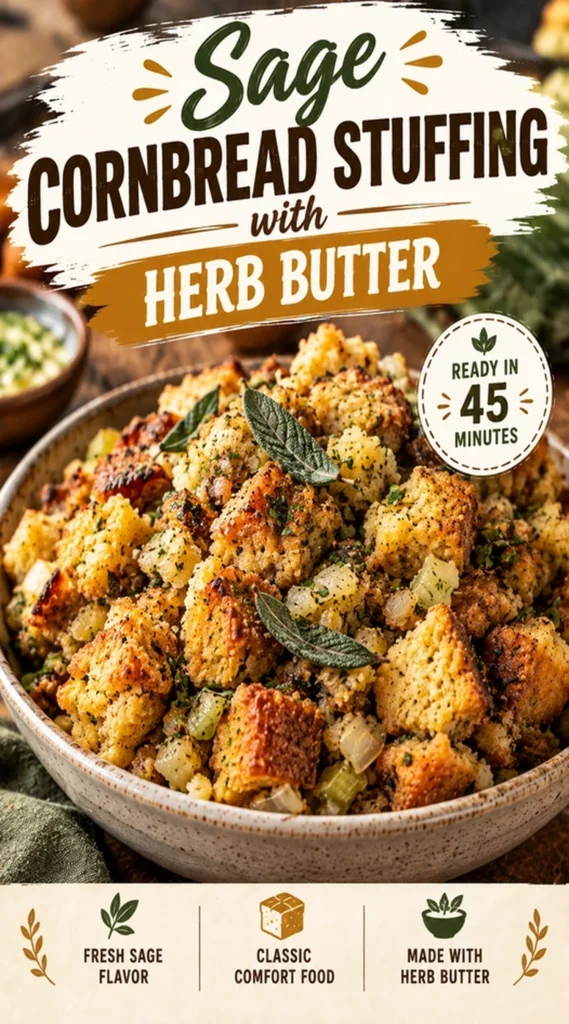
This stuffing moves beyond the standard bread cube approach by using a dense, golden cornbread base that absorbs savory liquids without becoming mushy.
The result is a side dish that balances the natural sweetness of corn with the earthy, pungent punch of fresh sage.
Readers appreciate this version for its sturdy texture and the way the herb butter creates a crisp, browned crust on top.
It differs from store-bought mixes aromatics and real butter, avoiding the salty, artificial taste of pre-packaged stuffing.
This recipe is ideal for those who want a side dish that feels elevated but remains accessible to home cooks of all skill levels.
It pairs exceptionally well with roast turkey or a Garlic Butter Lemon Herb Chicken Easy Healthy Weeknight Dinner Recipe
Follow the guide below to master this aromatic accompaniment.
- ●Why You’ll Love This Recipe
- ●A Brief Background on Cornbread Stuffing
- ●Perfect For Holiday Feasts and Sunday Dinners
- ●Cornbread Spotlight
- ●Herb Butter Spotlight
- ●Key Ingredients
- ●How to Make It
- ●Pro Tips
- ●Delicious Variations
- ●Best Ways to Serve
- ●Storage and Leftovers
- ●Frequently Asked Questions
- ●Why This Recipe Belongs in Your Weekly Rotation
- ●Final Thoughts
This stuffing offers a complex profile that hits multiple taste notes in every bite.
- ●The cornbread provides a satisfying, hearty crumb.
- ●Fresh sage adds a sophisticated, woody aroma.
- ●Herb butter creates a golden-brown, caramelized top layer.
- ●The moisture level is balanced, preventing a dry finish.
- ●It is more filling than traditional white bread stuffing.
- ●Preparation is straightforward and requires minimal equipment.
- ●The flavors intensify as the dish rests.
- ●It works as a standalone side or a pairing for various proteins.
- ●The recipe is easily scalable for large crowds.
- ●It brings a nostalgic, home-cooked feel to the table.
These elements combine to make the dish a reliable centerpiece for any savory meal.
A Brief Background on Cornbread Stuffing |
Cornbread stuffing is a staple in many regional American cuisines, particularly where corn was historically the primary crop. Unlike wheat-based versions, cornbread adds a subtle sweetness and a coarser grain that holds up well against heavy stocks.
The addition of sage is traditional because the herb cuts through the richness of the butter and corn. When combined with a compound herb butter, the flavors are layered rather than blended, allowing each ingredient to stand out.
This specific approach focuses on the contrast between the soft interior and the crisp edges, ensuring the dish isn’t one-dimensional in texture.
The final result is a rustic, comforting side that bridges the gap between a vegetable side and a starch.
Perfect For Holiday Feasts and Sunday Dinners |
This recipe is a natural fit for large holiday gatherings. Its ability to be prepared in a large baking dish makes it easy to serve a dozen people at once without needing multiple pans.
For Sunday family dinners, it provides a comforting element that pairs well with slow-roasted meats or hearty stews. The rich flavors make it feel like a special occasion dish even on an ordinary weekend.
Meal prep is also possible cornbread and chopping the vegetables in advance, leaving only the final assembly and baking for the day of the event.
Cornbread Spotlight |
Cornbread serves as the structural foundation of this dish. Its crumb is denser than white bread, which allows it to soak up chicken or vegetable stock without losing its shape.
The corn adds a mild sweetness that complements salty ingredients like celery and onion. If you prefer a more savory profile, using Irresistible Savory Cornbread Muffins Perfectly Buttery Treats as the base is an excellent choice.
Herb Butter Spotlight |
The herb butter acts as both a flavoring agent and a finishing touch. herbs directly into softened butter, the fats carry the aromatic oils of the sage and parsley deeper into the stuffing.
When placed on top of the stuffing before baking, the butter melts and fries the top layer of cornbread cubes. This creates a textural contrast that is often missing in traditional recipes.
Using high-quality unsalted butter allows for better control over the overall sodium levels of the dish.
Key Ingredients |
Each component plays a specific role in creating the final flavor profile.
- ●Cornbread — The primary base that provides texture and a hint of sweetness.
- ●Unsalted Butter — Adds richness and carries the herb flavors.
- ●Fresh Sage — Provides the signature earthy, aromatic flavor.
- ●Celery — Adds a fresh, salty crunch.
- ●Onion — Provides a savory, aromatic foundation.
- ●Chicken or Vegetable Stock — Moistens the bread and integrates the flavors.
- ●Fresh Parsley — Adds a bright, grassy note to balance the richness.
- ●Garlic — Adds depth and a pungent kick.
- ●Salt and Black Pepper — Essential for enhancing all other flavors.
How to Make It |
Follow these steps to achieve a balanced, flavorful stuffing with a perfect crust.
- Prepare the cornbread: Cube your cornbread into one-inch pieces and spread them on a baking sheet. Toast them in a low oven until they feel dry to the touch; this prevents the stuffing from becoming soggy.
- Sauté the aromatics: Melt a portion of the butter in a large skillet over medium heat. Add the diced onion and celery, cooking until the onion becomes translucent and the celery softens. Avoid browning the vegetables too deeply, as a light sauté preserves their fresh flavor.
- Infuse the garlic and sage: Stir in the minced garlic and chopped fresh sage. Cook for only about one minute until the fragrance is released. Cooking the sage in butter helps release its essential oils more effectively than adding it raw.
- Mix the base: Transfer the sautéed vegetables into a large mixing bowl with the toasted cornbread cubes. Toss gently to ensure the butter and aromatics are evenly distributed across the bread.
- Hydrate the mixture: Slowly pour in the stock while stirring gently. Stop when the bread is moist but not swimming in liquid. The mixture should hold its shape when pressed with a spoon.
- Prepare the herb butter: Mash softened butter with chopped parsley and a pinch of salt. This compound butter will be used as a topping to create the crust.
- Bake the stuffing: Transfer the mixture to a greased baking dish. Dot the top with the herb butter. Bake at 350°F (175°C) until the top is golden brown and the edges are crisp. You know it is ready when the top looks toasted and the center feels firm.
1Use these techniques to refine the texture and flavor of your stuffing.
- ●2Dry your bread: Always toast the cornbread cubes first. Fresh cornbread absorbs liquid too quickly, which often leads to a porridge-like consistency.
- ●3Use fresh herbs: While dried sage is available, fresh sage has a more complex, less bitter flavor.
- ●4Control the stock: Add the liquid in stages. Different cornbreads have different densities and will absorb liquid at different rates.
- ●5Room temperature butter: Ensure the butter for the herb topping is truly softened, not melted, for a better spread and melt.
- ●6Rest the dish: Let the stuffing sit for 10 minutes after removing it from the oven. This allows the moisture to redistribute evenly.
Delicious Variations |
You can adapt this recipe to suit different dietary needs or flavor preferences.
- ●Sausage Addition: Brown half a pound of Italian or breakfast sausage and mix it in with the aromatics.
- ●Apple Twist: Add diced Granny Smith apples for a sweet and tart contrast to the sage.
- ●Nutty Crunch: Fold in toasted pecans or walnuts for added texture.
- ●Vegan Option: Use a vegan cornbread base, plant-based butter, and vegetable stock.
- ●Cheesy Finish: Sprinkle a layer of Gruyère or Parmesan cheese over the top before adding the herb butter.
These variations allow the recipe to transition from a traditional holiday side to a more modern accompaniment.
Best Ways to Serve |
This stuffing is versatile and can be presented in several ways depending on the meal.
- ●As a side for roast turkey, ham, or chicken.
- ●Served in individual ramekins for a more formal presentation.
- ●Paired with a tart cranberry sauce to cut through the richness.
- ●Served alongside roasted root vegetables like carrots and parsnips.
For a casual brunch, you can scoop a small amount of stuffing into a toasted English muffin and top it with a poached egg.
If serving for a crowd, keep the stuffing in the baking dish and place it on a trivet in the center of the table to maintain heat.
Storage and Leftovers |
Refrigerating
Store leftover stuffing in an airtight container in the refrigerator for up to 4 days. Ensure it is cooled completely before sealing to prevent moisture buildup.
Reheating
Reheat portions in the oven at 325°F (160°C), covered with foil, for 15-20 minutes. Adding a tablespoon of stock before reheating helps restore the original moisture.
Freezing
Wrap the stuffing tightly in foil and plastic wrap, then place it in a freezer bag for up to 3 months. Thaw in the refrigerator overnight before reheating in the oven.
Frequently Asked Questions |
- ●Q: Can I use a store-bought cornbread mix for this recipe?
A: Yes, you can use any store-bought cornbread. However, ensure you bake it and let it cool completely before cubing. If the mix is particularly sweet, you may want to increase the amount of salt or add a bit more celery to balance the flavor. - ●Q: What can I use if I don’t have fresh sage?
A: If fresh sage is unavailable, you can use dried sage, but use only one-third of the amount. Dried herbs are more concentrated and can become overpowering if used in the same quantity as fresh. Thyme is also a decent substitute for a similar earthy flavor. - ●Q: My stuffing turned out too dry. How can I fix it?
A: If the stuffing is too dry after baking, you can drizzle a small amount of warm chicken or vegetable stock over the top and cover it with foil for 5-10 minutes in the oven. This will steam the interior and soften the texture. - ●Q: How do I prevent the stuffing from becoming mushy?
A: The most important step is to toast your cornbread cubes. Fresh bread acts like a sponge and absorbs liquid too quickly. in the oven first, you create a barrier that allows the liquid to coat the bread rather than saturate it. - ●Q: Can I make this stuffing in a slow cooker?
A: While possible, a slow cooker will not produce the crisp, browned top that an oven does. To mimic the effect, you can brown the aromatics in a pan first, then cook on low for 3-4 hours, though the texture will be softer and more uniform.
Why This Recipe Belongs in Your Weekly Rotation |
While often reserved for holidays, this cornbread stuffing is a powerhouse of flavor that works throughout the year. Its combination of complex herbs and hearty grains makes it a satisfying addition to any roasted meal.
The ability to customize the ingredients means it can evolve with the seasons, shifting from a bright spring side with parsley to a deep, wintery accompaniment with sage and sausage.
Integrating this dish into your repertoire ensures you always have a reliable, impressive side that feels like a treat without requiring hours of labor.
Final Thoughts |
This Sage Cornbread Stuffing with Herb Butter combines a sweet-and-savory base with an aromatic herb topping to create a superior side dish. It balances textures and flavors to provide a sophisticated alternative to standard bread stuffing.
Bringing this recipe into your kitchen allows you to serve a dish that is both comforting and refined. It is a versatile option that adapts to your favorite proteins and dietary preferences.
Gather your fresh herbs and cornbread to create a savory masterpiece that your guests will remember.
Sage Cornbread Stuffing with Herb Butter
- Total Time: 55 minutes
- Yield: 6-8 servings 1x
Description
A savory blend of toasted cornbread, fresh sage, and aromatics, finished with a rich herb butter crust for a perfect balance of texture and flavor.
Ingredients
- 6 cups cubed cornbread
- 1/2 cup unsalted butter, divided
- 1 medium onion, finely diced
- 2 stalks celery, finely diced
- 3 cloves garlic, minced
- 2 tablespoons fresh sage, chopped
- 2 cups chicken or vegetable stock
- 2 tablespoons fresh parsley, chopped
- 1 teaspoon salt
- 1/2 teaspoon black pepper
Instructions
- Preheat oven to 350°F (175°C). Toast cornbread cubes on a baking sheet for 10-15 minutes until dry.
- In a large skillet, melt 4 tablespoons of butter over medium heat. Sauté onion and celery until translucent.
- Stir in minced garlic and chopped sage, cooking for 1 minute until fragrant.
- Place toasted cornbread in a large bowl and fold in the sautéed vegetable mixture.
- Gradually pour in the stock, stirring gently until the bread is moist but not saturated.
- Season with salt and black pepper.
- Transfer the mixture to a greased 9×9 inch baking dish.
- Mix the remaining butter with chopped parsley. Dot the herb butter across the top of the stuffing.
- Bake for 25-30 minutes until the top is golden brown and crisp.
- Prep Time: 20 minutes
- Cook Time: 35 minutes
- Category: Side Dish
- Method: Baking
- Cuisine: American